
Thanks to our Historical Society’s project to digitize the Perkasie News-Herald’s archives, we can now look back to 1881 and see how Perkasie Borough celebrated Thanksgiving Day during that decade.
Local History
My writings and research on the history of Perkasie.
After 111 years, a new Walnut Street Bridge for Perkasie
On Wednesday, November 21, 2018, Perkasie will witness an event that only happens every century or so – the opening of a new bridge on Walnut Street over the Perkiomen’s East Branch.
The Delaware River Covered Bridge Network (Part 2)
The first wooden covered bridges built in Bucks County bore little resemblance to the dozen that survives today. At one time, 11 great bridges spanned the Delaware River from Riegelsville to Trenton.
Discovering Bucks County’s Covered Bridges (Part 1)
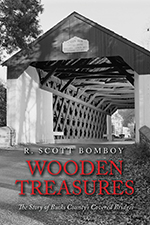
Bucks County is well-known for its history and an important part of that story is its collection of wooden covered bridges. Currently, 12 of the structures remain in the county, with 10 of the original bridges listed on the National Register of Historic Places.
The story of Perkasie area’s other Covered Bridge
As part of my project with the Bucks County Historical Society to inventory and map the county’s current and former Covered Bridges, I’m doing brief bios of each of the 57 bridges that existed here. Here’s a quick look at the little-known Steeley’s Bridge, which sat just outside of Perkasie.

One of its few photos. Courtesy of Trish Kane at Lostbridges.org.
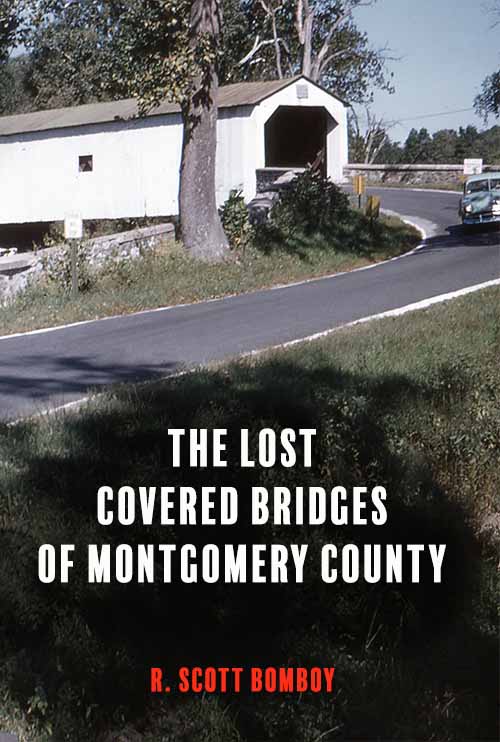
Today, Bucks County has 12 Covered Bridges, which is a lot for one county. Two of them are full reproductions; a third is the South Perkasie Covered Bridge sitting on land in Lenape Park.
The story behind those incredible Victorian birds’ eye view maps
You’ve seen them in gift shops, museum book stores and maybe you have one of them in your house: an aerial view of your hometown a generation before airplanes existed. The story behind these maps is fascinating, and the work of three researchers reveals secrets left behind nearly 100 years ago.

A handful of artists walked the American countryside drawing nearly 1,800 maps over a three-generation period that showed life in small towns and big cities from the Civil War until the early 1920s. Some of the maps are staggering in detail. Thaddeus M. Fowler, the most prolific artist of panoramic or birds’ eye view maps, spent four years drawing a highly detailed map of Allentown, Pa., right before his death in 1922. Fowler died at the age of 80 from complications caused by a broken leg; he was hurt while walking and drawing around Middletown, N.Y., in his 54th year as a map artist.
The story of South Perkasie’s forgotten first church

The first church in modern Perkasie was demolished about 100 years ago, but parts of the historic South Perkasie building could still be with us today.
If you drive up Main Street in South Perkasie just north of the The Perk, you’ll see a cemetery at the corner of East Market Street and Main. The cemetery is still used and it contains the some of the older gravesites in the Borough. That’s because a small church sat on the property from 1866 until 1917. The Bridgetown Evangelical Church predated Saint Andrew’s Union Church in South Perkasie by about a year.
Two decades later, bigger churches were built in the center of Perkasie in the 1880s. But the Evangelical Church played an important role in community life until its owner, the Evangelical Association, closed its doors and sold it for $106 at a public auction in April 1916.
How could the original meeting house for an important local religious group be closed and scrapped within 40 years? Part of the answer is related to church politics, and another has to do with economics.
Perkasie’s greatest day in baseball history
The sport of baseball has always played a role in the culture of Perkasie, from its early history of club teams to its role as the center of baseball making in the sport’s golden era. But a decade before the Hubbert family starting producing balls here for the major leagues in the 1920s, Perkasie had its biggest baseball day.

Baseball stars Coombs, Morgan, Bender and Oldring in the lost 1911 film, The Baseball Bug
On October 7, 1909, Perkasie’s town baseball team challenged the greatest team in Philadelphia sports history, Connie Mack’s Philadelphia Athletics, to a game across from Menlo Park. The outcome was as predicted, but it is still an incredible story.
It’s hard for use to imagine how important baseball was in 1909 in America’s culture. Earlier in the year, the Athletics opened the first steel-and-concrete baseball stadium, the ultra-modern Shibe Park, in Philadelphia. Perkasie had a town baseball team in the 1880s and the Central News in 1887 had its own team, led by Charles Baum.
Perkasie took part in a strong regional baseball group, the North Penn League, and was coming off a good season. The Central News (and Borough residents) were outraged that three bad decisions by “Umpire Griffith” cost the team the pennant in an away game at Ambler. Its star player, South Perkasie’s Joe Eldridge, was the league’s best pitcher. For insurance, the team added the league’s best home run hitter, Jimmy Cressman, who played for Souderton’s club, for the Athletics game. Cressman was the only North Penn League player to hit a home run off a major league pitcher.
Why is Perkasie called the place where hickory nuts are cracked?
That’s a good question. The Borough’s unofficial slogan came from a 1942 book about Bucks County place names. Whether the Lenape actually used those words to describe the area is up for debate.

Penn’s Treaty with the Lenape
The first reference to the “village” of Perkasie goes back to the time of James Logan, the personal secretary to the Penn family. Logan and a Lenape chief recalled in the 1730s a meeting in 1683 at the “Indian Village of Perkasie” between William Penn and Tamanend, the famous Lenape leader.
Penn acquired the lands that make up modern Perkasie, Sellersville, Hilltown and Rockhill in 1683 when he met Tamanend and other Indian leaders about six months after Lenape leaders and Penn held a conference at Shackamaxon, in present-day Philadelphia. Their first land negotiation occurred at an Indian village called Perkasie, which in contemporary times was said to be about 25 miles– a two-day’s journey by horse, from Philadelphia.
If needed, State police should also take up Perkasie’s unsolved murder
Note: This is the editoral I wrote for the Bucks County Herald in October.
On Sunday, Perkasie Borough police asked for help solving a 58-year-old murder mystery. I had requested this late this summer as a Perkasie council member, after stumbling on the case while researching another topic.
 Our police have shown due diligence in considering this matter and should be commended. I also hope two other key investigators in the original case, the Pennsylvania State police and Bucks County detectives, will take part if needed in the probe.

1929 Anniversary Book

This free high-definition scan of the 1929 Perkasie 50th Anniversary book is text searchable. Click here to download.
National Register of Historic Places

Listed
Delbar Products
South Perkasie Covered Bridge
Lehigh Valley Transit Station
Perkasie Park Camp-Meeting Grounds
Eligible
Perkasie Borough Central District
Bridgetown-South Perkasie District
Lake Lenape Park
North Pennsylvania Railroad
Perkasie Silk Company
Preservation Research

This is my final Historic Preservation project in 2017 for Bucks County Community College. Click here to get the PDF.